
Part 1: Determination of Spore Lethality at Low Ethylene Oxide Gas Concentrations at Atmospheric Pressure
D.L. Woodman, W.K. Andersen, and A.E. May
Abstract
The use of a flexible chamber as part of an ethylene oxide (EO) sterilization system was first describ-ed in 1959. Since the 1960s, flexible-chamber EO sterilization systems have been in continuous use in the United States and around the world.
Ethylene oxide flexible-chamber systems offer distinct advantages, including efficient gas usage, very low risk of harm to the sterilization load (no steam injection or deep vacuum), and the ability to process small lots of product efficiently.
This paper describes spore lethality at low EO concentrations in
flexible-chamber EO sterilization systems and is Part 1 of two recent studies on the characteristics of this sterilization method.
Introduction
Flexible chambers have been used for ethylene oxide (EO) sterilization for more than 50 years. During this time, most published EO
sterilization studies focused on traditional fixed chambers, whereas little has been published regarding relative humidity (RH), temperature, and EO concentration control and
uniformity in flexible chamber systems.
In October 2010, the AAMI Ethylene Oxide Sterilization Working Group began developing a Technical Information Report (TIR) on flexible-chamber EO sterilization systems. In the course of this development work, a number of questions arose regarding the science behind this sterilization method.
In answer to those questions, a series of studies were undertaken to provide more data on the
lethality and the unique charact-
eristics of flexible chamber EO sterilization.
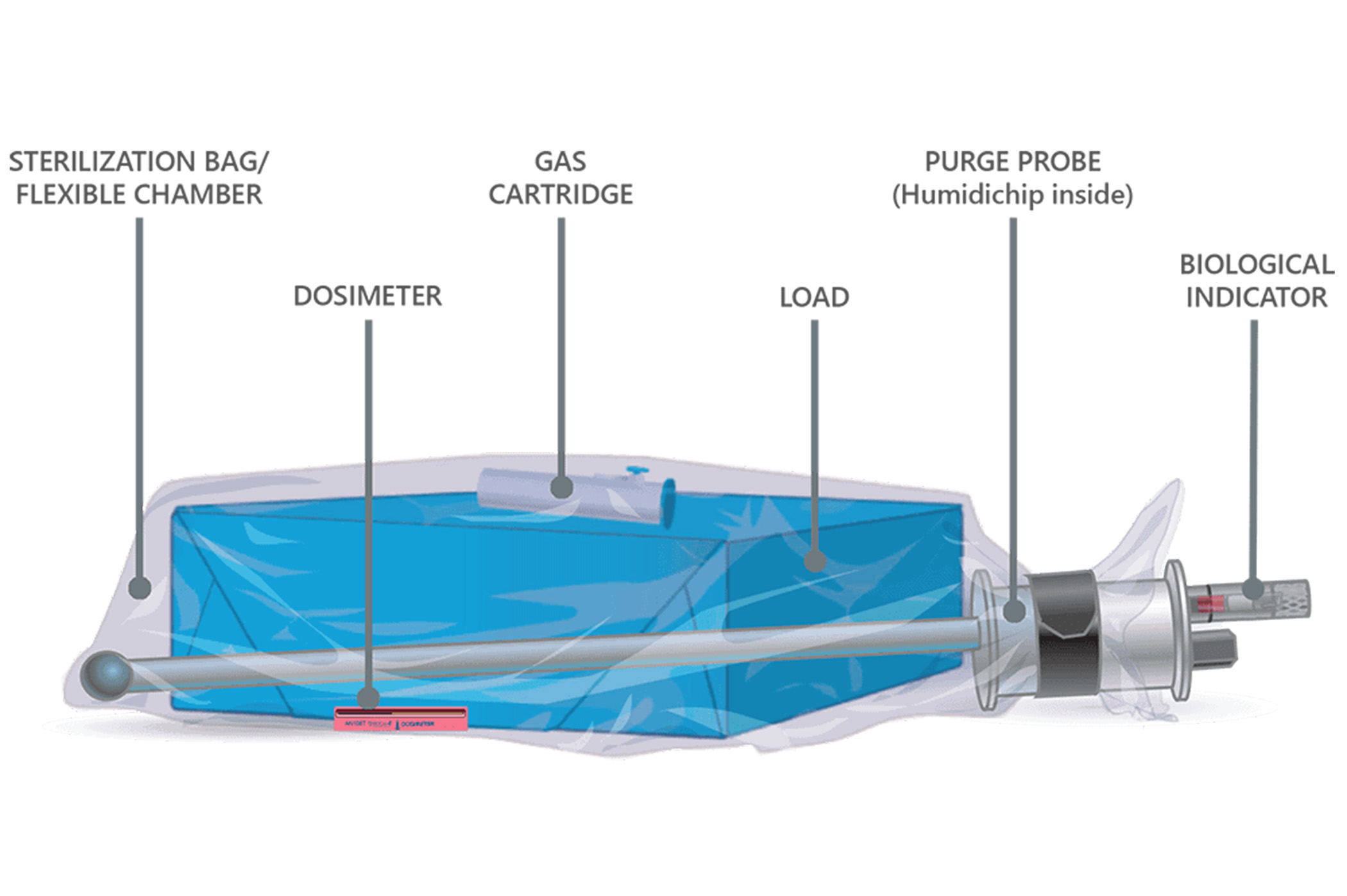
The flexible chamber consists of a sterilization bag manufactured from either a permeable or impermeable plastic film
Technicians place the product
to be sterilized into the flexible bag, along with a humidity control device (if used).
Ethylene oxide gas can either be injected into the sealed bag or dispensed from a unit-dose device containing a known amount of EO which is placed into the flexible bag before it is sealed. The flexible bag is then placed within a sterilization cabinet designed to maintain the bag
contents at sterilization temperature.
EO is removed from the bag either by a
passive diffusion process, in permeable bag systems, or by mechanical means when impermeable bags are used. Depending on the size of the cabinet, one or more flexible sterilization bags can be processed simultaneously.
Flexible-chamber EO systems are characterized by very small load volumes and serve an important niche in the processing of Industrial Ethylene Oxide Sterilization 16 Industrial Sterilization small lots, very delicate or custom devices that require strict control of temperature and/or humidity, and applications in which in-house processing of small batches is essential.
This paper explores a number of the critical parameters of flexible-chamber systems and offers a mathematical model to calculate cycle lethality. Specifically, this article will demonstrate the following:
1. That the relationship between EO concentration and spore lethality within a flexible sterilization bag is identical to the lethality kinetics within a traditional fixed chamber.
2. That low concentrations of EO in a flexible sterilization bag can inactivate spores (i.e.,bioburden).
3. That there is a correlation between low EO concentration and cycle lethality (expressed as the reciprocal of D-values).
4. That a mathematical model can be used to predict total log kill within a sterilizationcycle using three variables: gas concentration (milligrams per liter [mg/L]), temperature (°C), and time (minutes).
5. That the mathematical model can be applied to an existing validated flexible-chamber EO sterilization process in order to calculate a theoretical log reduction of bioburden over the full exposure cycle. When D-values are determined at different EO gas concentrations, total spore log reduction (SLR) can be calculated using the mathematical model, and the mathematical model can be applied to an established, validated cycle.
Read Part 1 and Part 2 as published in AAMI in Oct. 2013.
Part One and Part Two